Tag: Emotionally Manageable Fantasy

  • The Blacksmith Queen Review: A Violent, Joyful Fantasy with a Hammer-Ready Heroine

    The Blacksmith Queen Review: A Violent, Joyful Fantasy with a Hammer-Ready Heroine

    A broad-shouldered blacksmith, a family that loves by getting in the way, and a fantasy world where gore becomes comic rhythm.

    There is a moment in G.A. Aiken’s The Blacksmith Queen when Keeley wakes up surrounded by demon wolves.

    To nearly everyone else in the story, these are terrifying creatures with flaming eyes and an uncertain relationship with the rules of ordinary animal behavior. To Keeley, they are friends who have climbed into bed because they were cold. When Caid discovers them, she tries to explain that the situation is not what it looks like, then turns around and scolds the wolves because not everyone understands their relationship.

    This scene captures much of what I love about this book.

    The world is dangerous. The creatures are strange. The violence is real. Keeley’s response to nearly everyone and everything is to befriend them, protect them, argue with them, put them to work, or tell them to behave.

    Some books feel emotionally manageable because they are gentle. The Blacksmith Queen is not gentle. It contains murderous rulers, family betrayal, warfare, dismemberment, internal organs, dragons, centaurs, magical horses, and more dangerous relatives than any one family should reasonably contain.

    It is loud, bloody, chaotic, and frequently outrageous. It is also an unexpectedly joyful book.

    The Blacksmith Queen is a useful reminder that the opposite of emotional burnout is not always comfort.

    Sometimes it is delight.

    Far Lantern Reader Snapshot

    This book is best for:

    Readers who enjoy highly competent heroines, medieval secondary worlds, dry and irreverent humor, affectionate families who show love by annoying one another, strange magical creatures, over-the-top action, and romance that supports the adventure without taking it over.

    This book’s emotional intensity:

    Medium. The violence and stakes are substantial, but humor, momentum, strong relationships, and Keeley’s practical resilience keep the story from becoming relentlessly grim.

    Review spoiler level:

    Spoiler-light. This review includes a few specific comic scenes, relationship details, and broad comments on the direction of the series, but does not reveal the central twists or ending.

    Landing note:

    This is the first book in a trilogy and ends on a cliffhanger. The reading experience remains emotionally manageable, but the book does not provide a clean standalone landing. Readers who need a fully settled ending should plan to continue into Book Two.

    Reader note:

    This is not cozy or gentle fantasy. It contains frequent violence, graphic gore, and torture. Much of the violence is presented through exaggerated action and dark comedy, but it is still clearly described. The book also contains profanity and on-page sexual content that uses explicit language. Readers who are sensitive to graphic violence may not find the humor enough to soften it.

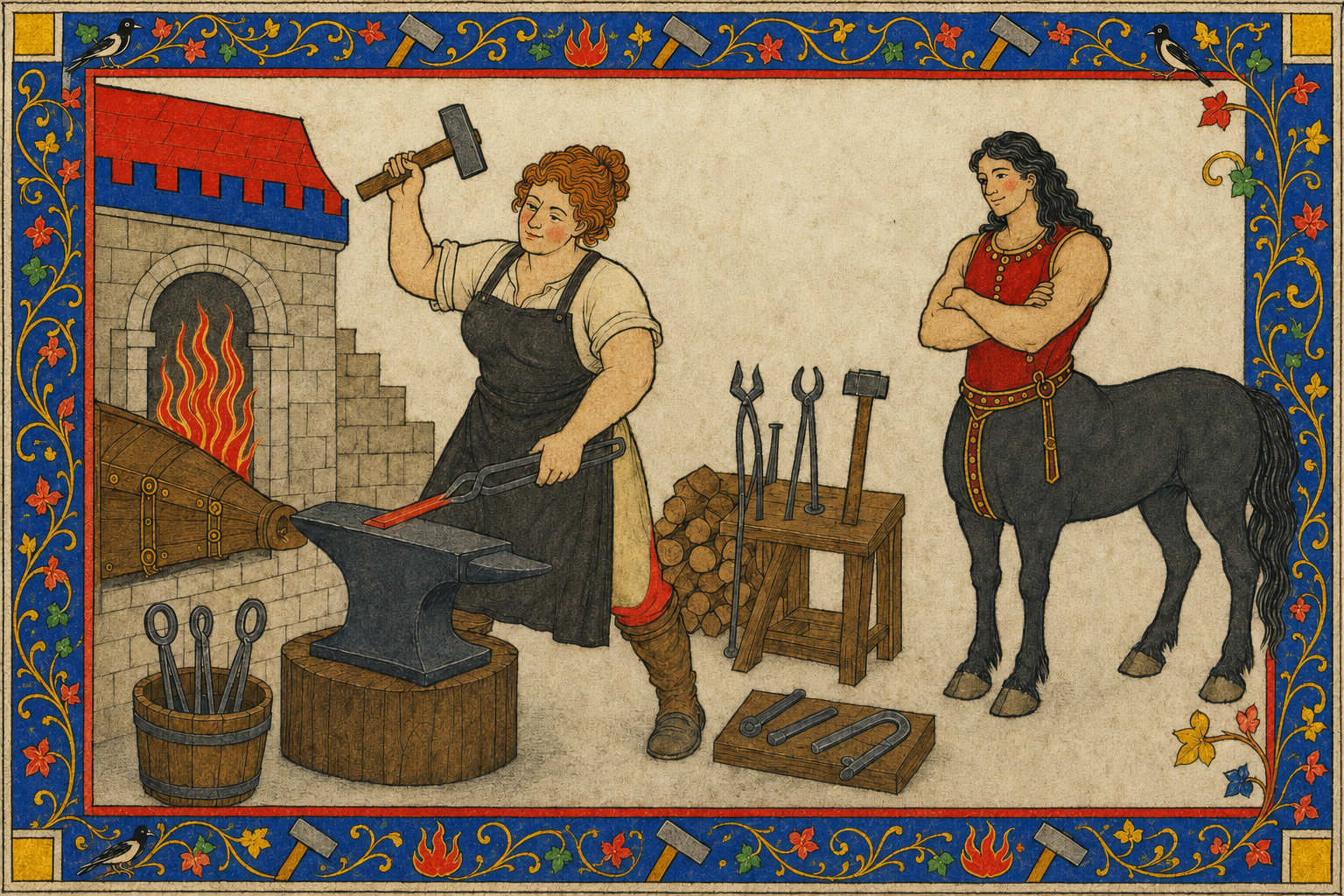
    Medieval manuscript-style village with stone cottages, winding paths, a well, and an open blacksmith forge framed by a blue floral border.
    Original editorial illustration inspired by the novel’s themes, featuring a medieval village and working forge.

    The Pleasure of Keeley Being Keeley

    Keeley Smythe is a blacksmith—not a decorative fantasy blacksmith who makes one important sword before discovering she was destined for something grander. She has customers, employees, orders to fill, horseshoes to repair, and a large family that relies on her work.

    When she learns that she may be meant for a much larger role, she does not react with excitement. She looks around as though someone may have confused her with another woman. She wants to return to her forge.

    She has work waiting.

    The moment is funny, but it also reveals why Keeley is already suited to leadership. A title does not create her importance; it merely recognizes qualities formed through years of labor, responsibility, and care.

    Keeley is enormously strong and comfortable using that strength, but her ability to win a fight is only part of her appeal. Her strength is generous. She provides for people, protects strangers, and respects animals rather than assuming they should submit to her. To Keeley, power is not permission to dominate.

    That instinct also shapes how she responds to the strange. Her competence feels lived-in, rooted in habit and character rather than a special title or carefully defined magical gift.

    Her goodness is broad-shouldered, loud, practical, protective, and hammer-ready.

    The book also pushes against a familiar fantasy pattern. The lithe, fair, polished woman is not automatically the good one, and the large, loud, physically powerful woman is not cast as a brute, comic relief, or villain. Keeley’s size and strength are part of her goodness rather than qualities she must overcome.

    The romance with Caid reinforces that refusal to diminish her. He is reserved where Keeley is open and affectionate, but he never asks her to become quieter, more graceful, or less powerful. Their connection develops through shared travel and growing comfort, and Caid is strong enough to stand beside her without the story weakening her first. He does not fight for Keeley while she waits somewhere safe. He fights with her.

    A Family That Loves by Getting in the Way

    Keeley’s family helps give the story its emotional warmth, although no one would mistake them for a peaceful household.

    They tease, interrupt, argue, threaten one another with nearby objects, and involve themselves in business that is not technically theirs. Their affection appears through crowding, provocation, constant inclusion, and the confident assumption that everyone will stay involved whether they asked to be or not.

    They are annoying because they are close.

    One of my favorite family moments involves Keeley giving her younger sister Endelyon a hammer. Endelyon responds with exactly the level of enthusiasm a small child in this family would have, immediately declaring her authority through the possession of a weapon.

    Keeley’s cousin Keran is a dangerous fighter whose usual preparation for departure seems to involve oversleeping, rushing outside, vomiting, announcing that she is fine, and getting on her horse. Keeley’s response is practical: at least Keran can fight.

    That is the family rhythm. They irritate one another constantly, but the irritation grows out of familiarity rather than indifference. When the danger becomes real, they act. No one is expected to face a serious threat alone.

    Their love is invasive, noisy, and frequently irritating.

    It is still love.

    When Gore Becomes Comic Rhythm

    Aiken’s humor is not something added between action scenes to give the reader a break. It shapes the emotional rhythm of the entire book.

    The banter is funny, but so are the abrupt escalations and the characters’ failure to respond to horror in the expected way. A scene can move from graphic violence to exhausted annoyance in a single beat.

    At one point, a character is simply tired of it: “He was tired of getting hit with men’s insides.”

    That deadpan shift is central to Aiken’s comic world: the gore remains gore, and the villains still murder, torture, betray, and destroy in pursuit of power, but Keeley, the strange creatures, the rapid pace, and the humor keep that cruelty from controlling the book’s atmosphere for long.

    That comic framing will not work for everyone. A reader who dislikes graphic gore may still find the book too much, no matter how absurd the surrounding scene becomes. Emotional manageability is not the same as an absence of disturbing content.

    For readers who respond to Aiken’s particular combination of dry humor and outrageous violence, however, the darkness becomes part of the book’s momentum rather than a weight that stops the story.

    A World That Should Be Too Much

    Beneath all the chaos is a recognizable medieval-fantasy structure. There are villages, castles, forests, blacksmiths, horses, swords, axes, rival rulers, and a world shaped by labor and physical distance.

    Then Aiken begins adding things.

    Large black dragon with raised wings and a curled tail standing on grass inside a blue illuminated-manuscript border.
    Original editorial illustration inspired by the novel’s themes, featuring a black dragon in a medieval manuscript style.

    I do not want to spoil the pleasure of discovering just how expansive—and absurd—this world becomes, but the demon wolves are only the beginning. New creatures, peoples, gods, and factions continue arriving with such confidence that, in another novel, the world might feel hopelessly overstuffed.

    Here, the excess remains pleasurable because Aiken’s prose stays clear and easy to follow. She avoids pausing to explain every new creature or custom, while small details—such as the presence of two moons—quickly establish that this is a secondary world rather than historical Europe. The reader can stop measuring it against history and begin learning its own rules.

    The result feels like a large cinematic fantasy world colliding with a clan of Amazonian-adjacent women armed with hammers, dry humor, and very little patience for traditional queenly behavior.

    It is medieval fantasy with the volume turned up.

    Book One Is Strongest Because of Keeley

    The Blacksmith Queen begins a trilogy and ends on a cliffhanger rather than offering a fully self-contained landing. Readers who continue will find that the later books gradually widen their focus beyond Keeley.

    That widening matters. Book One is strongest because of Keeley. She remains important, but she is not merely one enjoyable member of a large ensemble.

    Keeley’s practical warmth and comic unflappability make her the emotional center of the first novel.

    The second book continues much of the same joy. The humor, action, outrageous characters, family chaos, and strange world remain strong even as the focus shifts.

    The third book is less cohesive. It brings in many characters connected to Aiken’s larger Dragon Kin world, and the expanding viewpoints and intersecting plotlines begin to muddle the story. Too much happens through too many people at once.

    None of this weakens the recommendation of The Blacksmith Queen. It simply clarifies what the rest of the series offers. The later books continue the world, humor, and wider cast, but they do not reproduce the exact Keeley-centered pleasure of the beginning.

    Who Will Enjoy The Blacksmith Queen

    This is not cozy fantasy, even though it contains animals, family warmth, domestic comedy, a practical heroine, and a romance with genuine tenderness. It is not restrained or solemn epic fantasy either.

    Aiken does not make the world safer than it is. She gives the reader Keeley, her family, the rapid pace, and enough humor and justice to keep the danger from becoming oppressive. The result is especially well suited to readers who enjoy physically powerful and unconventional heroines, crowded medieval-fantasy worlds, strange creatures, dry irreverent humor, affectionate families who show love by driving one another crazy, and graphic action tempered by comic rhythm.

    Long before anyone considers calling her a queen, Keeley has already earned authority through her work and the way she cares for and protects others.

    Readers sensitive to graphic violence or explicit content should approach carefully. The humor changes the experience of those elements, but it does not make them disappear.

    The title may call Keeley a queen.

    The book’s real pleasure is that she never stops being a blacksmith.

    For readers looking for an exciting, strange, violent fantasy that offers delight rather than emotional exhaustion, The Blacksmith Queen is wonderfully difficult to resist.

    Read next: Emily Wilde’s Encyclopaedia of Faeries Review

    Browse Book Reviews →

    Looking for more books with atmosphere, wonder, competence, and a clean emotional landing?

    I made a free Far Lantern reading list with 10 immersive books chosen for readers who love getting lost in a story — without being emotionally wrecked by one.

    Featured image: Original editorial illustration inspired by the novel’s themes, rendered in a medieval manuscript style.

  • Books You Can Get Lost In Without Emotional Burnout

    Books You Can Get Lost In Without Emotional Burnout

    For readers who want the doorway, not the disaster.

    Some books offer another world without asking the reader to survive an emotional disaster first.

    That is the kind of book Far Lantern is built around.

    Not necessarily gentle books. Not necessarily cozy books. Not books where nothing difficult ever happens. The stories I return to often have danger, romance, strange magic, hidden worlds, capable heroines, formidable heroes, family pressure, secrets, grief, or longing.

    But they do not make anxiety the main reading experience.

    There is a difference between tension and dread. There is a difference between emotional depth and emotional punishment. There is a difference between a story that takes the reader through dark places and a story that leaves the reader sitting there too long.

    That difference is the heart of Far Lantern.

    The reading instinct behind it began early. As a young reader, I could not relax into a book until I knew whether the ending was one I could live with. Not because surprise had no appeal, but because the wrong kind of ending could change the whole experience of a book. It was easier to enter a story after knowing whether the landing was one worth trusting.

    Later, that instinct turned into hours of wandering library shelves: long, slow browsing sessions, pulling books down, reading covers, sampling pages, trying to sense the emotional weather before committing to the journey.

    The search was not always easy to define. For a long time, the clearest thing was what the book should not be.

    Not built around humiliation.

    Not full of cruelty that lingered.

    Not endless angst.

    Not a bully romance.

    Not emotional chaos dressed up as depth.

    Not the kind of story that made ordinary life feel heavier after closing the cover.

    What took longer was learning how to name the positive version of that taste. The goal was never only “soft books.” Softness can be lovely, but softness alone is not enough. A story can be gentle and still feel thin. A romance can be low-conflict and still feel emotionally weightless. A cozy premise can still leave the reader unsatisfied if there is not enough structure, movement, or depth underneath it.

    The real desire was for something more specific: immersion with narrative trust.

    A book can include danger, grief, violence, heat, monsters, strange magic, or difficult emotional territory and still leave the reader steady at the end. The question is not whether anything bad happens. The question is whether the story knows how to carry what happens.

    For me, an emotionally manageable book usually has some combination of agency, competence, justice, structure, humor, payoff, protection, or forward movement. The heroine does not have to be perfect. She does not have to begin the story fully powerful. She can be inexperienced, afraid, wounded, or uncertain. But she cannot simply be dragged through suffering for the sake of drama.

    There has to be some way through.

    A clean landing does not only happen in the final chapter. It happens in smaller moments along the way: a threat answered, a cruel person checked, a problem solved, a door opened, a skill used well, a safe room found, a friend arriving at the right time, a heroine discovering that she is not as powerless as she has been told.

    Those small resolutions matter. They tell the reader that the larger danger has a shape. They create trust.

    A book can hold one large, overarching threat and still feel steady if the story gives enough smaller moments of resolution along the way. Without those moments, tension can turn into dread. Darkness can stop feeling meaningful and start feeling like atmosphere without mercy.

    That is where emotionally manageable reading differs from both pure coziness and emotional devastation.

    It is not afraid of dark places.

    It simply refuses to live there.

    If that is the kind of reading mood you are looking for, I made a short Far Lantern list for it: books with atmosphere, magic, romance, danger, softness, strangeness, or edge — chosen because they offer narrative trust.

    Gentle Is Not Always the Same Thing

    The word gentle can be helpful, but it can also be misleading.

    A gentle romance can be beautiful. A quiet story about a woman slowly claiming her own life can be deeply satisfying. But gentle can also suggest low risk, low danger, and not enough story underneath.

    For me, the important question is not, “Is this book gentle?”

    The better question is: “Does this book know how to carry its darkness?”

    If the heroine is capable, if the danger has boundaries, if the story keeps moving, and if the payoff feels earned, a book can be far more emotionally manageable than a supposedly cozy story that feels thin, aimless, or emotionally unsatisfying.

    That is why Far Lantern is not simply a cozy-reading project.

    It is about immersive escape with enough narrative trust to make the journey worth taking.

    The Book That Clarified the Feeling

    Clean Sweep by Ilona Andrews is the book that clarified this for me.

    Before that, the preference existed, but the definition was blurrier. There were books that worked and books that did not. There were shelves of softer romances, fantasy novels with enough distance to make danger feel bearable, and familiar authors who seemed to understand how to build tension without making the reader feel punished by it.

    But Clean Sweep brought the pattern into focus.

    It is not pure cozy fantasy. The book has monsters, injuries, animal deaths, werewolves, vampires, interstellar guests, and horror-adjacent elements. Its world is too strange, too dangerous, and too sharp-edged to be simply soft.

    Yet it never feels emotionally chaotic.

    Dina makes the difference.

    She is already competent. She knows her magic. She understands the inn, the rules of her world, the danger of exposing ordinary humans to things they are not meant to see, and the responsibilities that come with her position. Her inn is young, her circumstances are not effortless, and the threat around her is real, but Dina herself is steady.

    That steadiness changes the reading experience. The living inn gives the story refuge and structure, while Dina gives it calm authority.

    Clean Sweep helped name the thing I had been looking for: not a book without darkness, but a book with enough competence, charm, structure, and narrative trust to make the darkness readable.

    That is why it remains a benchmark Far Lantern recommendation.

    It has teeth, but it also has a clean landing.

    Read the Full Clean Sweep Review

    The Soft Side of the Doorway

    The Blue Castle by L. M. Montgomery belongs to the same larger reading mood, but from a different direction.

    There are no magical inns or monsters. The danger is quieter: a diminished life, a suffocating family, and a woman who has been trained to think of herself as small. The pleasure of the book comes from watching Valancy slowly step outside the role assigned to her.

    It is a gentle book, but not an empty one.

    That distinction matters. The Blue Castle works because the gentleness has movement. There is pressure and release. There is a before and after. There is independence, romance, restoration, and the satisfaction of watching a woman begin to believe that the life arranged around her is not the only life available.

    At a certain point in my life, that movement toward independence mattered to me personally. Not in a loud, dramatic way, but in the quieter sense of seeing a heroine become less willing to let other people’s expectations define the shape of her life.

    That is part of why the book feels so restorative. The romance is gentle and clean, but the deeper satisfaction is Valancy’s change in relation to herself.

    For me, that gives The Blue Castle its emotional weight. It is soft, but it is not thin. Its gentleness has consequence because the feelings are held inside a world with structure.

    The Dangerous Side of the Doorway

    On the other side is The Inheritance by Ilona Andrews.

    That book is not gentle. Its danger begins quickly, and much of the unease comes from strangeness: an unfamiliar world, survival pressure, body-strangeness, and the sense that the environment itself does not follow ordinary rules.

    But it still feels trustworthy.

    The heroine is not drifting helplessly through the strange. She has obligations, pressure, and reasons to keep moving. The story has momentum. The danger has shape. The world is unsettling, but it is not vague. There is enough competence and forward motion to keep the book from becoming emotionally punishing.

    That is another version of the same reading promise.

    Sometimes a book is manageable because it is soft.

    Sometimes it is manageable because the heroine is capable enough to carry the reader through danger.

    Both can belong.

    What does not belong, at least not here, is the kind of book that seems to confuse suffering with depth.

    Who This Reading Mood Is For

    This is for readers who want the doorway, not the disaster.

    It is for readers who love immersive stories but do not want to dread reading them: readers drawn to atmosphere, romance, magic, danger, old worlds, strange houses, hidden kingdoms, capable heroines, formidable heroes, social pressure, secret rooms, living houses, and worlds that feel larger than ordinary life.

    But not constant emotional punishment.

    It is probably not for readers who want to be devastated by every story. There are readers who love the sobbing, the spiral, the emotional wreckage, the book that leaves them torn up and ready to talk about how much it hurt.

    That is a valid reading mood.

    It is just not this one.

    Far Lantern is also not only for readers who want pure comfort, no sharp edges, no heat, no darkness, and no difficult places. Too much gentleness can become bland. Too little danger can make a story feel thin. The books that work best often have some shadow in them.

    The shadow gives the light something to do.

    The point is not to avoid every difficult thing. The point is to find books where difficulty is held inside a story that still offers agency, payoff, structure, and return.

    For readers who come to books already carrying enough anxiety, the right story may need to do something else.

    It can make life feel wider instead of heavier.

    Want a Place to Start?

    I made a short Far Lantern reading list for this exact mood: 10 Immersive Books That Won’t Emotionally Wreck You. The books on it are not all gentle, and they are not all alike. Some offer the softest landing. Some offer fantasy immersion with more movement. Some have stronger momentum, stranger worlds, romance, or more edge.

    I chose them because each one offers some kind of narrative trust: competence, atmosphere, justice, humor, romantic payoff, contained danger, emotional restoration, or a world that knows what it is doing.

    What they share is not a single genre or a single level of softness.

    What they share is the doorway.

    Far Lantern is for readers who want immersive books without emotional burnout: fantasy, classics, romance, mystery, and bookish escapes chosen for atmosphere, momentum, emotional manageability, narrative trust, and the promise of returning from the story steadier than you went in.

    Come back when you want your next quiet doorway into another world.

    Read next: How to Choose Your Next Book When You Want Story, Wonder, and a Clean Landing

    Browse Reading Lists →

  • Clean Sweep by Ilona Andrews

    Clean Sweep by Ilona Andrews

    A comfortingly strange magical-inn story anchored by competence, humor, and a heroine who already knows what she is doing

    Some books work because they explain the doorway before asking you to step through it. Clean Sweep does something I like even better: it opens as if you already belong in Dina Demille’s world and trusts you to catch up.

    From the beginning, the book drops you into werewolves, a magical inn, interdimensional guests, something not-quite-earthly threatening the neighborhood, and a heroine who speaks to her house like it can understand her — because it can. There is not a long pause to explain every rule of innkeepers, magical inns, or the larger interstellar world. The story simply begins, and that confidence is part of what makes it so immediately immersive.

    Far Lantern Reader Snapshot

    This book is best for:

    magical inns, hidden worlds, competent heroines, dry humor, light romantic tension, cozy-strange science fantasy

    This book’s emotional intensity:

    Medium-low

    Review spoiler level:

    Spoiler-light. This review discusses premise, tone, character dynamics, and general reader experience, but avoids major plot turns.

    Reader note:

    This is not a complete romance arc in Book 1, and it is not pure cozy fantasy. There are monsters, injuries, animal deaths, and horror-adjacent elements. But the danger is handled with enough competence, humor, and structure that the book still feels emotionally manageable.

    Why Dina Works So Well

    The strongest reason Clean Sweep works for me is Dina herself.

    I love that Dina is already in command of her magic. This is not a story about a heroine fumbling her way into power or learning, chapter by chapter, how to stop making magical mistakes. Dina’s inn may be young, and she may still be trying to build its reputation and attract guests, but she already knows what she is doing. Her relationship to her magic is strong and clear.

    That kind of competence matters to me. Dina is not just magically gifted; she understands the rules of her world, the boundaries of her inn, the needs of her guests, and the danger of exposing ordinary humans to things they are not supposed to know exist.

    But she is not neutral in the coldest sense. When something dangerous begins threatening her neighborhood, Dina knows she is supposed to stay within certain innkeeper rules. She also knows she could not live with herself if someone were hurt and she had done nothing. That choice is what made me trust her. She is not reckless for drama’s sake. She is protective because protection is part of who she is.

    The Inn Is the Heart of the Book

    And then there is the inn.

    The thing that stood out most clearly is that Gertrude Hunt is not just magical. The inn is a character. Dina speaks to it. The inn responds. It warns her, protects her, worries over her, and occasionally seems to take offense. One of the first moments that made me attached to it was Dina reassuring the inn after Sean insults it. That immediately gave the house a personality.

    Later, when Dina is injured, the inn’s response makes that bond feel even more real. Gertrude Hunt does not feel like a backdrop. It feels protective, responsive, and emotionally present — but Dina is still the innkeeper.

    The inn may worry over her, but it does not take the story away from her.

    That balance is one of the book’s quiet strengths.

    Why It Feels Strange but Manageable

    I would describe Clean Sweep as comfortingly strange. It is too weird, too dangerous, and too interstellar to be straight cozy, but it never feels emotionally chaotic. The weirdness has walls, rooms, rules, food, and someone competent at the center. There are strange creatures, vampire politics, interstellar cultures, and doors that open far beyond Earth, but the story gives the reader enough structure to enjoy the strangeness without feeling unmoored.

    The humor helps too. One of the small pleasures of the book is watching Dina calmly let overconfident men discover that her inn is not their territory. Sean tries to understand her through the limited hierarchy he knows — werewolf strength, territory, intimidation — while the vampires bring a different kind of comedy, trying to behave correctly on Earth and getting it just wrong enough to stand out. It has the feeling of tourists misunderstanding local customs, except these tourists are armored, deadly, and very concerned with honor.

    And Caldenia is her own kind of delightful terror: the kind of character who can casually say something horrifying and somehow make the scene funnier instead of darker.

    That is one of Ilona Andrews’ gifts. Something can be traditionally horrific, but written in a way that feels sharp, strange, and fun rather than emotionally punishing.

    The romance is present, but it is not the main payoff of Book 1. By the end, Dina’s feelings are clearly becoming harder for her to dismiss, but the relationship is still in setup mode rather than payoff mode.

    The romantic appeal also carries that very Ilona Andrews style of dominant, dramatic, slightly over-the-top hero who works because the heroine is not overwhelmed by him. I have a soft spot for the way Ilona Andrews writes this kind of man: arrogant, dangerous, powerful, and then softened by a heroine who can actually meet him. It is tropey, yes, but it is also part of the appeal.

    But the real center of Clean Sweep is not the romance. It is Dina, the inn, and the pleasure of watching a capable woman manage a very strange world with calm authority.

    I would hand this book to readers who want magical competence, dry humor, hidden-world fantasy, a living inn, a protective heroine, and a first book that makes you want to keep reading the series. I would not hand it to someone looking for high steam, a finished romance arc, or a soft magical-house story with very little danger.

    For me, Clean Sweep is a benchmark Far Lantern recommendation: strange, immersive fantasy with a self-possessed heroine, a living magical refuge, and enough danger to feel exciting without becoming emotionally draining.

    Read next: Books Like Clean Sweep for Readers Who Want Magic, Competence, and Calm.

    Browse all Book Reviews →

    Looking for more books with atmosphere, wonder, competence, and a clean emotional landing?

    I made a free Far Lantern reading list with 10 immersive books chosen for readers who love getting lost in a story — without being emotionally wrecked by one.