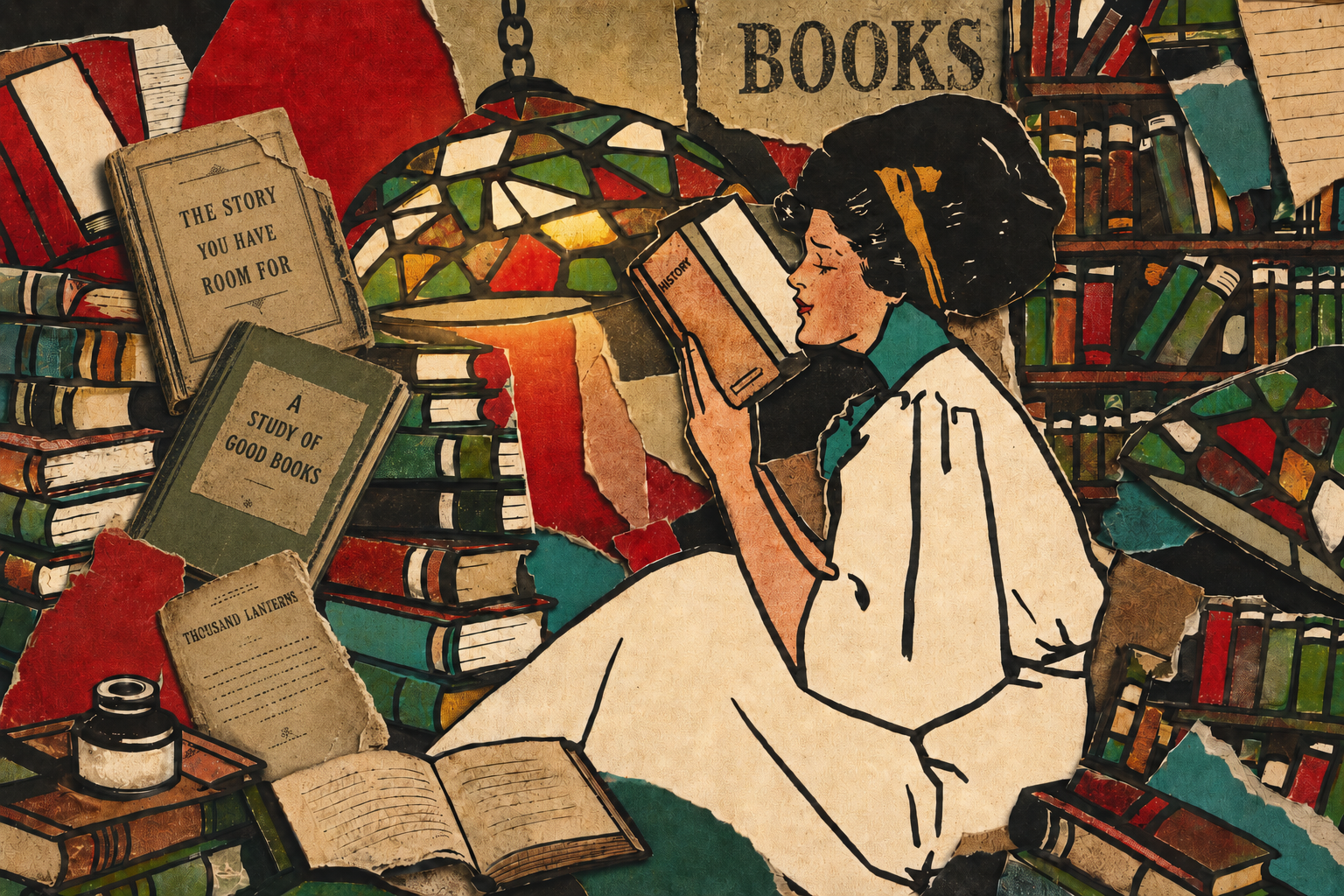
Sometimes choosing the next book is harder than it should be.
Not because there are too few choices. Usually because there are too many — and because “good book” is not always the same thing as “the right book for right now.”
There is also the small, familiar worry that comes with choosing: what if the book you pick is not as good as the one you leave on the shelf? What if you choose the wrong doorway? What if the story asks for more than you wanted to give it?
That is where I think a different kind of reading lens can help.
For me, choosing the next book is not only about genre, rating, popularity, or whether a book sounds impressive. It is about the kind of reading experience I have room for.
Do I want another world to enter — something soft, strange, romantic, atmospheric, or dangerous without tipping into despair?
That is the Far Lantern reading lens: story, wonder, and a clean landing.
Not books where nothing difficult ever happens, but books with enough structure, atmosphere, and emotional trust to make the journey feel worth taking.
Spoiler level: Light. This guide discusses premise, tone, emotional direction, and one remembered scene from The Bride, but avoids major endings.
The Far Lantern Lens
I ask whether a book offers three things:
- Story — enough shape to carry me.
- Wonder — a world, atmosphere, romance, or strangeness that opens the door wider.
- A clean landing — enough trust, payoff, competence, justice, or restoration to bring me through intact.
A Simple Way to Choose
When I am trying to choose what to read next, I try to ask three questions.
Not complicated questions.
Just enough to help me tell the difference between a good book and the right book for right now.
First:
What kind of story do I have room for?
Do I want momentum, a romance arc, a mystery, a capable heroine solving problems, a quieter emotional restoration, or a survival story with enough shape to carry me forward?
Second:
What kind of wonder am I looking for?
Do I want a hidden world, a living inn, old magic under the ground, strange powers with rules of their own, a house that seems to know more than it should, a forest that feels watchful, or a door opening into a world bigger than ordinary life?
Or do I want a quieter kind of wonder: atmosphere, romance, historical texture, eerie refuge, or simply the feeling that ordinary life is not the only available room?
Third:
What kind of landing do I need?
Do I need softness, justice, humor, romance payoff, a protective place, a competent heroine, or a story with enough structure that danger will not become emotional chaos?
Those three questions help me choose by experience instead of only by category.
Because “fantasy” can mean almost anything.
So can “romance.”
So can “comfort read.”
The better question is: what kind of doorway is this book offering, and do I want to step through that doorway today?
Start with the Kind of Story You Have Room For
When I say I want story, I do not mean a book has to be fast or action-heavy.
Some of my favorite books move quietly. Some spend time in rooms, households, villages, libraries, old houses, dangerous woods, strange inns, or social worlds where one glance can carry half a chapter’s worth of feeling.
But I do need some kind of movement.
A book can be gentle and still feel thin if nothing inside it seems to gather force. A book can be beautifully written and still feel oddly difficult to enter if there is no shape to the experience. For the kind of emotionally manageable escape I’m looking for, I want the sense that the story knows where it is going, even if I do not.
That movement might be loud or quiet. It might come from a mystery unfolding, a romance gathering force, a danger being faced, or a heroine slowly becoming less willing to live inside the life assigned to her.
Clean Sweep: Danger with Boundaries
When I want story with movement, magic, dry humor, and competence, Clean Sweep by Ilona Andrews is one of my benchmark examples.
The book begins with strangeness and danger almost immediately. There is something not-quite-earthly threatening the neighborhood, a magical inn with its own personality, werewolves, vampires, interstellar guests, and a heroine who understands far more than the ordinary world around her can see.
But what makes the book feel manageable is not the absence of danger.
It is Dina.
She is already competent. She knows the rules of her inn, the responsibilities of her role, and the cost of exposing ordinary people to things they are not meant to know. The story moves because she can move through it with purpose. She may be worried, injured, irritated, protective, or caught between rules and conscience, but she is not helpless inside her own book.
That kind of story-shape matters.
It gives the reader someone steady to follow.
When I know I want competence, hidden-world magic, humor, and danger with boundaries, I would reach for something like Clean Sweep.
But if I want a quieter kind of story, I might choose differently.
The Blue Castle: Opening the Window
In The Blue Castle by L. M. Montgomery, the movement is not monsters or magic or hidden worlds. It is Valancy moving out of the suffocating role her family has assigned her.
The danger is emotional rather than supernatural: a diminished life, small humiliations, family pressure, years of being treated as if her wants do not matter. But the story still has movement. There is a before and after. There is pressure and release. There is the pleasure of watching a woman begin to believe that the life arranged around her is not the only life available.
That is story too.
Not constant stakes, but a way forward.
When what I really want is restoration, independence, and the feeling of a window opening after years in a stuffy room, The Blue Castle is closer to the right doorway than something faster or stranger.
The choice is energy, not genre.
What kind of story do I have room for right now?
Choose the Kind of Wonder You Want
Wonder does not always mean literal magic.
Sometimes wonder comes from atmosphere.
A business district run by beings who regard humans as prey. A candlelit magical household. An old social world of manners and letters. A Highland keep. A heroine entering a life that feels older, stranger, more dangerous, and more romantically heightened than the one she came from.
That is why genre is only the starting point.
A fantasy book can be emotionally exhausting. A romance can feel like escape. A classic can feel more magical than a book with actual spells in it.
The better question is what kind of wonder the book offers.
Eerie Refuge: Written in Red
A book like Written in Red by Anne Bishop offers wonder through place. Its comfort is not soft in the ordinary sense. It is eerie. The appeal is sanctuary with teeth: a young woman escaping captivity, the Lakeside Courtyard becoming her first safe place, and dangerous powers whose protection can feel more trustworthy than ordinary society.
That kind of wonder is not decorative.
The place matters. The danger matters. The rules matter. The feeling is not, “Nothing can hurt me here.” It is closer to, “The frightening things nearby may understand justice better than the people causing harm.”
That is a very particular kind of comfort.
Quiet, but not toothless.
When I want atmosphere, refuge, unfamiliar rules, strange justice, and the feeling of a dangerous community choosing to protect someone vulnerable, Written in Red is closer to the right doorway.
But if I want romantic escape instead of eerie refuge, that is a different kind of wonder.
Romantic Escape: The Bride
The Bride by Julie Garwood is not fantasy, and there is no quiet magic in the literal sense. But Jamie, its English heroine, helps show how historical romance can work as its own kind of emotional fantasy: a dangerous old-world setup softened and reshaped into humor, attraction, household competence, and romantic payoff.
The real-world premise is not safe. A young English woman is sent into marriage with a powerful Scottish laird. In a more realistic version, that setup could become bleak very quickly.
But that is not the version the book offers.
The fantasy is not dragons or spells. The fantasy is that this unsafe premise becomes a place where the heroine is valued, where her competence matters, where her disruptions become funny and useful, where danger stays contained enough for romance to grow.
That is part of why I have returned to it more than once. The Highland atmosphere and older romance structure create a familiar kind of escape, but Jamie’s competence is what makes it satisfying: the household changes, the clan politics become funny, and the hero who meant only to do his duty finds himself falling for her despite himself.
It is not Far Lantern’s central lane.
But it does sit at the edge of the map.
And sometimes the edge of the map helps explain the center.
When choosing the next book, it helps to ask what kind of wonder you actually want: literal magic, eerie atmosphere, romantic escape, a protective place, or a world that feels larger than ordinary life.
The answer changes the recommendation.
Decide What Kind of Landing You Need
This is the part I care about most.
A clean landing does not mean the book has no shadows.
It means the book knows how to carry its darkness.
Difficulty can be held by many things: a capable heroine, a protective place, a romance with real payoff, a strong plot shape, humor, justice, friendship, practical problem-solving, or the sense that the author knows where the story is going.
That trust matters more to me than softness alone. Some books are gentle and still feel emotionally weightless. Some books have danger, grief, or cruelty and still feel manageable because the story gives the reader a way through.
A clean landing also does not only happen at the end.
It happens in smaller moments along the way.
A threat answered.
A cruel person checked.
A skill used well.
A safe room found.
A community beginning to stand behind her before she fully realizes it.
The Bride shows this in a very old-school romance way. Jamie handles a rival-clan crisis with complete practical focus: everyone else sees politics, insult, and possible war; Jamie sees a sick baby, a shouting man, and the immediate need for goat’s milk.
The danger is there, but the emotional turn is toward competence, humor, and belonging.
That is a clean landing in miniature: not because nothing could have gone wrong, but because the story knows how to turn danger into something held.
Different books answer that need differently. In Clean Sweep, the landing comes from competence, humor, structure, and the living refuge of the inn. In The Blue Castle, it comes from emotional release and selfhood. In Written in Red, it comes from eerie protection and justice. In The Bride, it comes from romance payoff, practical competence, humor, and belonging inside an old-school historical setup.
Those are not the same landing. That is the point.
A clean landing can have different textures. The trick is knowing which one you need today.
In practice, I try not to start with the question of which book is objectively best.
I ask what I need the book to do today.
Carry me with competence? Give me emotional restoration? Offer refuge? Promise romance payoff? Open the world a little wider?
And if I am already stretched thin, I pay attention to warning signs. Not because I only read soft books, but because not every good book is good for every week.
Signs a Book May Be Too Draining for This Mood
I try not to treat this as a moral judgment on books.
Some readers want devastation. Some readers want the sobbing, the spiral, the book that leaves them emotionally wrecked and ready to talk about it for days. That is a real reading pleasure for many people.
But it is not the Far Lantern mood I am talking about here.
For this mood, I become cautious when a book seems built around humiliation, cruelty, helplessness, or emotional chaos. I become cautious when the dread starts earlier than curiosity, or when the story seems to confuse suffering with depth.
A book may be too draining if every good thing feels temporary, every safe place is immediately destroyed, every relationship becomes a trap, or the main character is dragged through suffering without enough agency, relief, humor, justice, or payoff.
Again, that does not mean the book is bad.
It may simply be asking for more emotional recovery than I want to spend.
I wish more book recommendations made room for that distinction.
Sometimes the question is not, “Is this book worth reading?”
Sometimes the question is, “Is this book the right doorway today?”
The Far Lantern Check
This is the simplest version of the lens.
By story, I mean enough shape to carry me: plot, romance, mystery, emotional movement, practical problems, danger with boundaries, or a heroine finding a way forward.
By wonder, I mean the world opens somehow: through magic, atmosphere, romance, old houses, strange rules, hidden places, historical texture, eerie sanctuary, quiet beauty, or the feeling that ordinary life is not the only available room.
By a clean landing, I mean the book may have shadows, but it does not abandon me inside them. It offers some combination of competence, protection, humor, justice, payoff, emotional restoration, or narrative trust.
The clean landing is not always perfectly soft.
Sometimes it is Dina standing in her inn, knowing what she is doing.
Sometimes it is Valancy stepping into a life that finally has air in it.
Sometimes it is Meg finding refuge among beings who understand protection and justice better than the humans hunting her.
Sometimes it is Jamie treating a clan crisis like a practical problem while danger gathers around her.
Different books.
Same deeper need.
A doorway.
Not the disaster.
A Place to Start
If this is the kind of reading experience you are looking for, I made a short Far Lantern reading list for it: immersive books with atmosphere, magic, romance, danger, softness, strangeness, or edge — chosen because they offer narrative trust.
The books on it are not all gentle.
They are not all alike.
But they were chosen because each one gives the reader a way through: a capable heroine, a protective place, a clean landing, contained danger, romantic payoff, humor, justice, emotional restoration, or a world that knows where it is going.
The point is not to avoid every difficult thing.
The point is to choose books that give you somewhere to go — and bring you back with something intact.
Start with my free reading list, 10 Immersive Books That Won’t Emotionally Wreck You.
Far Lantern is for readers who want immersive books without emotional burnout: fantasy, classics, romance, mystery, and bookish escapes chosen for atmosphere, momentum, emotional manageability, and narrative trust.
Come back when you want your next quiet doorway into another world.
Suggested next reading: For more on this kind of immersive-but-manageable escape, read Books You Can Get Lost In Without Emotional Burnout.
Explore Guides & Essays →